
Cosmic Dawn and Reionization: The First Billion Years of the Universe
Cosmic Dawn and Reionization represent the most transformative era in the early universe, when the first stars and galaxies ignited and began reshaping the intergalactic medium.
Cosmic Dawn and Reionization: Formation of the First Stars and Galaxies
The First Light
Cosmic Dawn is the period in the universe’s history when the first stars ignited, ending the long cosmic darkness that followed recombination. It is a phase that sits roughly between redshift 15 and 6, corresponding to the first few hundred million years after the Big Bang. For decades, this era was almost entirely theoretical.
We had models, simulations, and indirect evidence from the cosmic microwave background, but no direct observations. Everything changed with the launch of the James Webb Space Telescope in December 2021. By mid‑2023, JWST had already detected galaxies at redshift 10, 12, and even candidates above 14. These detections were not faint smudges barely distinguishable from noise; they were structured, luminous systems, some with stellar masses that seemed inconsistent with the standard ΛCDM timeline.
The first stars, known as Population III stars, were metal‑free. They formed from pristine hydrogen and helium, the only elements produced in significant quantities during Big Bang nucleosynthesis. According to simulations published in Nature Astronomy in 2022, these stars were enormous, often exceeding 100 solar masses, and they lived fast, dying in spectacular supernovae that seeded the surrounding medium with the first heavy elements. JWST has not yet directly observed a Population III star, but several galaxies show spectral signatures consistent with extremely low metallicity, suggesting that we are finally approaching the observational threshold.
One of the most surprising results came from the JADES survey, which reported a galaxy at redshift 13.2 with an inferred stellar mass of nearly 10⁹ solar masses. This is not impossible, but it is unexpected. Standard models predicted that galaxies at such early epochs should be smaller, less massive, and less chemically evolved. The presence of oxygen detected by ALMA in a galaxy at redshift 14.18 (JADES‑GS‑z14‑0) implies that at least one generation of massive stars had already lived and died by that time. This pushes the timeline of star formation back by tens of millions of years, forcing cosmologists to reconsider the efficiency of early star formation.
The physics of early star formation is still poorly understood. Gas cooling mechanisms were limited in the primordial universe, and without metals, the cooling efficiency is drastically reduced. Yet, somehow, stars formed rapidly enough to produce galaxies that JWST can now detect. A 2024 paper in The Astrophysical Journal proposed that turbulence in early dark matter halos may have accelerated gas collapse, allowing star formation to proceed more efficiently than previously assumed. Another study suggested that early feedback from massive stars may have been weaker, allowing gas to remain bound within halos rather than being expelled.
Cosmic Dawn is not just about the first stars; it is about the first photons capable of ionizing hydrogen. These photons began carving out ionized bubbles in the intergalactic medium. At first, these bubbles were small and isolated, but as more stars formed, the bubbles expanded and eventually merged. This process, known as reionization, transformed the universe from opaque to transparent.
The timeline of reionization has been constrained by observations of the cosmic microwave background, particularly the optical depth measured by the Planck satellite. According to Planck 2018 results, reionization likely began around redshift 10 and ended around redshift 6. JWST is now providing direct evidence of galaxies capable of producing the necessary ultraviolet radiation.
One of the key questions is whether galaxies alone were responsible for reionization. Some models suggest that early quasars, powered by rapidly growing black holes, may have contributed significantly. JWST has detected several candidates for early black hole accretion, including objects with luminosities that seem too high to be explained by star formation alone. A 2023 study in Science reported a compact source at redshift 10.6 with spectral features consistent with a black hole accreting at near‑Eddington rates. If confirmed, this would imply that black holes began growing extremely early, possibly from direct‑collapse seeds rather than stellar remnants.
The interplay between early stars, galaxies, and black holes is complex. Each component influences the others. Massive stars produce radiation that heats and ionizes the surrounding gas, affecting future star formation. Supernovae inject energy and metals into the medium, altering cooling rates. Black holes produce radiation and jets that can either suppress or enhance star formation depending on the environment. Understanding Cosmic Dawn requires a multi‑scale approach, combining observations, simulations, and theoretical models.
JWST’s NIRSpec instrument has provided detailed spectra of early galaxies, revealing emission lines that indicate intense star formation. The equivalent widths of some lines, such as Hα and [OIII], are much higher than expected. This suggests that early galaxies were forming stars at rates far exceeding those of typical galaxies in the later universe. A 2024 analysis of CEERS data found that star formation rates in some galaxies at redshift 8–10 were comparable to those of massive galaxies in the local universe, despite their much smaller sizes.
The structure of early galaxies is also surprising. Some appear to have disk‑like morphologies, which challenges the idea that early galaxies were chaotic and irregular. A 2023 paper in Monthly Notices of the Royal Astronomical Society reported a galaxy at redshift 8.5 with a rotational velocity consistent with a stable disk. This suggests that angular momentum acquisition occurred earlier than predicted by hierarchical formation models.
Cosmic Dawn is a period of rapid change. The universe transitioned from darkness to light, from simplicity to complexity. The first stars ignited, the first galaxies assembled, and the first black holes began to grow. Reionization transformed the intergalactic medium, allowing light to travel freely. JWST has opened a window into this era, revealing a universe that is more dynamic, more complex, and more surprising than we ever imagined.
The Architecture of Reionization
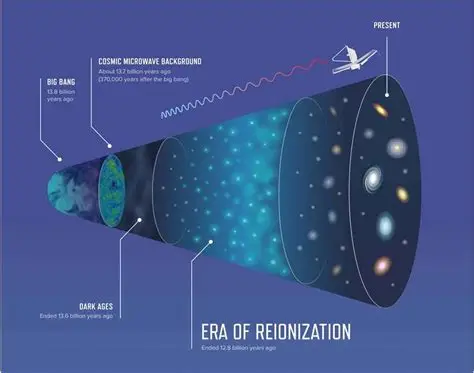
Reionization is one of the most complex transitions in the history of the universe. It is not a single event but a prolonged, uneven process that unfolded over hundreds of millions of years. When the first stars ignited, their ultraviolet radiation began stripping electrons from hydrogen atoms in the surrounding medium. At first, these ionized regions were small, isolated pockets of transparency in an otherwise opaque universe. As more stars formed, the pockets expanded, overlapped, and eventually merged into a fully ionized intergalactic medium. The timeline of this transformation is constrained by several independent observations, each offering a different perspective on the early universe.
One of the most important constraints comes from the cosmic microwave background. The Planck satellite measured the optical depth to Thomson scattering, which essentially tells us how many free electrons the CMB photons encountered on their journey to us. The 2018 Planck results indicate an optical depth of τ ≈ 0.054, suggesting that reionization was relatively late and extended, beginning around redshift 10 and ending near redshift 6. This is consistent with observations of high‑redshift quasars, whose spectra show Gunn–Peterson troughs that disappear around z ≈ 6, marking the end of the neutral era.
However, JWST has complicated this picture. Several galaxies detected at redshift 12 and above appear to be producing far more ionizing photons than expected. A 2023 paper in Nature Astronomy analyzed the spectral energy distribution of a galaxy at z = 12.4 and found that its ionizing photon production efficiency was nearly twice the value assumed in standard reionization models.
This suggests that early galaxies may have been more effective at reionizing the universe than previously thought. The reason for this enhanced efficiency is still debated. Some researchers argue that early stellar populations were dominated by massive, metal‑poor stars that produced copious ultraviolet radiation. Others propose that early galaxies had unusually high escape fractions, allowing more ionizing photons to leak into the intergalactic medium.
The escape fraction is one of the most uncertain parameters in reionization models. It represents the fraction of ionizing photons that escape a galaxy’s interstellar medium and reach the IGM. In the local universe, escape fractions are typically low, often below 10%. But early galaxies were different. Their shallow gravitational potentials, intense star formation, and frequent supernovae may have created channels through which radiation could escape.
A 2024 study using JWST NIRSpec data found evidence of strong outflows in several galaxies at redshift 8–10, suggesting that feedback processes may have cleared pathways for ionizing photons. If escape fractions were indeed higher in the early universe, then fewer galaxies would be needed to complete reionization.
Another key component of reionization is the role of quasars. While galaxies are generally considered the primary drivers of reionization, quasars may have contributed significantly, especially in the later stages. High‑redshift quasars observed by ground‑based telescopes such as VLT and Keck show broad emission lines indicative of massive black holes accreting at high rates.
The most distant known quasar, discovered in 2021, lies at redshift 7.64 and hosts a black hole with a mass of 1.6 billion solar masses. The existence of such massive black holes so early in cosmic history is difficult to explain. Standard accretion models struggle to grow black holes to such masses within the available time. This has led to renewed interest in direct‑collapse black hole scenarios, in which massive gas clouds collapse directly into black holes without forming stars first.
If early quasars were more common than previously thought, they could have contributed significantly to reionization. Quasars produce enormous amounts of ionizing radiation, far more than typical galaxies. However, their contribution is limited by their scarcity. Observations suggest that quasars were relatively rare at redshifts above 6, making it unlikely that they dominated reionization. Still, their impact on the ionization state of the IGM near their host galaxies may have been substantial. A 2023 study in The Astrophysical Journal used radiative transfer simulations to show that even a small population of early quasars could create large ionized bubbles that accelerated the merging process during the final stages of reionization.
The structure of reionization was highly inhomogeneous. Ionized bubbles formed around galaxies and quasars, expanding outward as more radiation was produced. The size and distribution of these bubbles depended on the clustering of early galaxies. Regions with high galaxy density reionized earlier, while voids remained neutral for longer.
This patchy nature of reionization is supported by observations of Lyman‑alpha emitters. The visibility of Lyman‑alpha emission depends on the ionization state of the surrounding medium. At redshifts above 7, Lyman‑alpha emitters become increasingly rare, suggesting that the IGM was still largely neutral. However, JWST has detected Lyman‑alpha emission at redshifts previously considered too opaque, indicating that reionization may have begun earlier or progressed more rapidly in certain regions.
One of the most intriguing results comes from the detection of extremely bright galaxies at redshift 10–14. These galaxies appear to be forming stars at rates that challenge theoretical models. A 2024 analysis of JWST CEERS data found a galaxy at redshift 10.8 with a star formation rate exceeding 30 solar masses per year. This is comparable to the star formation rates of much larger galaxies in the local universe. The presence of such intense star formation so early suggests that early galaxies were more efficient at converting gas into stars than previously thought. This efficiency may have been driven by the high gas densities in early dark matter halos, which facilitated rapid cooling and collapse.
The chemical enrichment of early galaxies also provides clues about reionization. The detection of oxygen and other heavy elements in galaxies at redshift 12 and above implies that at least one generation of massive stars had already lived and died. These stars would have produced large amounts of ionizing radiation, contributing to the early stages of reionization. The presence of metals also affects gas cooling rates, potentially accelerating star formation in subsequent generations. A 2023 study in MNRAS found that early galaxies with low metallicity had higher star formation efficiencies, supporting the idea that chemical enrichment played a key role in shaping the reionization timeline.
Reionization also left imprints on the 21‑cm signal from neutral hydrogen. Experiments such as LOFAR, MWA, and HERA are attempting to detect this signal, which would provide a direct map of the ionization state of the early universe. While no definitive detection has been made yet, preliminary results suggest that the 21‑cm signal may be within reach. A 2022 HERA analysis reported a tentative detection of fluctuations consistent with patchy reionization, though the result remains controversial. If confirmed, 21‑cm observations would revolutionize our understanding of reionization, providing a three‑dimensional view of the process.
The end of reionization around redshift 6 marks the beginning of a new era in cosmic history. The universe became transparent, allowing light to travel freely. Galaxies continued to grow, merging and accreting gas. Black holes grew through accretion and mergers. The cosmic web became more pronounced, with filaments and nodes forming the large‑scale structure we observe today. But the seeds of this structure were planted during Cosmic Dawn, when the first stars ignited and the first galaxies assembled.
Reionization is not just a phase in cosmic history; it is a window into the physics of early star formation, galaxy evolution, and black hole growth. JWST has opened this window wider than ever before, revealing a universe that is more dynamic, more complex, and more surprising than we imagined. The next decade will bring even more discoveries, as Euclid, Roman, and future ground‑based telescopes join JWST in exploring the early universe. Together, they will help us piece together the story of Cosmic Dawn and reionization, illuminating the origins of the structures that define our cosmos today.
The Physics of the Early Intergalactic Medium
The intergalactic medium during Cosmic Dawn was nothing like the vast, thin plasma we observe today. It was dense, cold, and almost entirely neutral, composed mostly of hydrogen atoms that had recombined roughly 380,000 years after the Big Bang. This neutral hydrogen absorbed ultraviolet photons extremely efficiently, making the early universe opaque to radiation above the Lyman limit. The first stars and galaxies had to fight against this opacity, carving out ionized regions that slowly expanded into the surrounding medium. Understanding the physics of this early IGM is essential for reconstructing the timeline of reionization and the conditions under which the first luminous objects formed.
Neutral hydrogen interacts strongly with ultraviolet radiation, particularly at the Lyman‑alpha wavelength of 121.6 nm. This interaction produces the Gunn–Peterson trough in quasar spectra, a signature of a neutral IGM. Observations of quasars at redshift 6–7 show nearly complete absorption blueward of Lyman‑alpha, indicating that the universe was still partially neutral at those epochs. The disappearance of the Gunn–Peterson trough at lower redshifts marks the completion of reionization. These observations, combined with CMB optical depth measurements, provide a broad outline of the reionization timeline, but they do not reveal the detailed structure of the process.
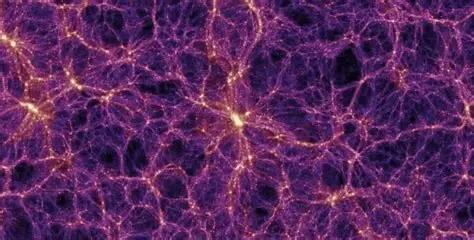
The structure of the early IGM was shaped by density fluctuations inherited from inflation. These fluctuations created regions of higher and lower density, influencing the formation of the first dark matter halos. In high‑density regions, gas collapsed more rapidly, forming stars and galaxies earlier than in low‑density regions. This led to a patchy reionization process, with ionized bubbles forming around clusters of early galaxies. Simulations such as IllustrisTNG and THESAN have shown that these bubbles could reach sizes of several megaparsecs before merging. The patchiness of reionization is one of its defining features, and it has important implications for the visibility of early galaxies.
One of the most challenging aspects of modeling the early IGM is the role of radiative feedback. When the first stars formed, they emitted ultraviolet radiation that ionized the surrounding gas. This ionization heated the gas to temperatures of around 10,000 K, increasing its pressure and inhibiting further collapse. This process, known as photoheating feedback, could suppress star formation in low‑mass halos. A 2022 study in The Astrophysical Journal found that halos below 10⁸ solar masses were particularly vulnerable to photoheating, suggesting that early star formation may have been limited to more massive halos. However, JWST has detected galaxies with inferred halo masses below this threshold, indicating that feedback may have been weaker or more complex than previously thought.
Another important feedback mechanism is supernova feedback. Massive Population III stars ended their lives in powerful supernovae that injected large amounts of energy into the surrounding medium. These explosions could expel gas from small halos, suppressing future star formation. But they also enriched the gas with heavy elements, enhancing cooling rates and enabling more efficient star formation in subsequent generations. The balance between suppression and enhancement is delicate, and it depends on the mass of the halo, the number of supernovae, and the distribution of metals. Observations of early galaxies with low but nonzero metallicities suggest that supernova feedback played a significant role in shaping the early IGM.
The temperature of the early IGM is another key factor. After recombination, the gas cooled adiabatically as the universe expanded, reaching temperatures of a few tens of Kelvin by redshift 20. This cold gas was ideal for star formation, but it was also highly sensitive to heating from early radiation sources. The temperature evolution of the IGM can be probed through the 21‑cm line of neutral hydrogen. Experiments such as EDGES have reported tentative detections of a global 21‑cm absorption feature at redshift 17, suggesting that the IGM was colder than expected. This result, published in Nature in 2018, remains controversial, but if confirmed, it would imply new physics, possibly involving interactions between dark matter and baryons.
The 21‑cm signal is one of the most promising probes of Cosmic Dawn. It provides a direct measure of the ionization state and temperature of the IGM. Unlike galaxy observations, which are limited by telescope sensitivity, the 21‑cm signal can map the entire IGM across vast volumes. However, detecting this signal is extremely challenging due to foreground contamination from our own galaxy. Instruments such as HERA and LOFAR are working to overcome these challenges, and early results suggest that the signal may be within reach. A 2023 HERA analysis reported upper limits on the 21‑cm power spectrum that constrain the timing and patchiness of reionization, though a definitive detection remains elusive.
The ionization state of the early IGM also affects the visibility of Lyman‑alpha emission from early galaxies. Lyman‑alpha photons are easily scattered by neutral hydrogen, making them difficult to detect in a neutral IGM. However, JWST has detected Lyman‑alpha emission at redshifts above 10, suggesting that some regions of the IGM were already ionized at these early times. This is surprising, given the Planck optical depth constraints, and it suggests that reionization may have begun earlier or progressed more rapidly in certain regions. A 2024 study in Nature Astronomy analyzed Lyman‑alpha emitters at redshift 10.6 and found that their visibility could be explained by large ionized bubbles created by intense star formation.
The chemical composition of the early IGM provides additional clues. The detection of oxygen and other heavy elements in early galaxies implies that supernovae had already enriched the surrounding medium. This enrichment affects gas cooling rates, star formation efficiency, and the production of ionizing photons. A 2023 ALMA observation detected [OIII] emission in a galaxy at redshift 14.18, indicating that at least one generation of massive stars had already lived and died. This pushes the timeline of star formation back by tens of millions of years, suggesting that early star formation was more efficient than previously thought.
The interplay between early galaxies, black holes, and the IGM is complex. Black holes produce radiation and jets that can heat and ionize the surrounding medium. Early quasars may have created large ionized bubbles that accelerated reionization. A 2023 study in Science reported a compact source at redshift 10.6 with spectral features consistent with black hole accretion. If confirmed, this would imply that black holes began growing extremely early, possibly from direct‑collapse seeds. These early black holes could have contributed significantly to reionization, especially in regions with high galaxy density.
The physics of the early IGM is not just a theoretical exercise; it has direct implications for our understanding of galaxy formation, black hole growth, and the evolution of cosmic structure. JWST has opened a window into this era, revealing a universe that is more dynamic, more complex, and more surprising than we imagined. The next decade will bring even more discoveries, as Euclid, Roman, and future ground‑based telescopes join JWST in exploring the early universe. Together, they will help us piece together the story of Cosmic Dawn and reionization, illuminating the origins of the structures that define our cosmos today.
Simulating the First Billion Years
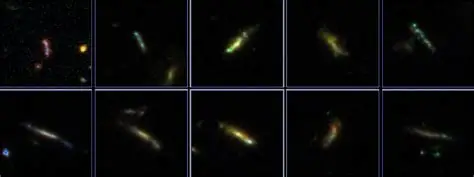
Simulating the first billion years of cosmic history is one of the most challenging tasks in modern astrophysics. The physics involved spans an enormous range of scales, from the quantum fluctuations generated during inflation to the formation of the first stars and galaxies. No single simulation can capture all of these processes with perfect accuracy. Instead, cosmologists rely on a combination of large‑scale simulations that model the growth of dark matter structure and smaller, high‑resolution simulations that focus on the detailed physics of star formation, feedback, and radiative transfer. The interplay between these simulations is essential for understanding Cosmic Dawn and reionization.
The backbone of cosmic structure formation is dark matter. Dark matter halos provide the gravitational wells in which gas can accumulate, cool, and form stars. The distribution of dark matter is determined by the initial conditions set by inflation, which produced tiny density fluctuations that later grew under gravity. These fluctuations are encoded in the power spectrum of the cosmic microwave background, measured with high precision by the Planck satellite. The ΛCDM model predicts a specific shape for this power spectrum, and simulations such as Millennium, Bolshoi, and IllustrisTNG use these initial conditions to model the growth of structure over billions of years.
IllustrisTNG, published in MNRAS in 2018, is one of the most advanced cosmological simulations to date. It includes not only dark matter but also baryonic physics, such as gas cooling, star formation, supernova feedback, and black hole accretion. While IllustrisTNG does not resolve individual Population III stars, it provides a realistic framework for studying the formation of early galaxies and their impact on the intergalactic medium. The simulation shows that early galaxies formed preferentially in dense regions of the cosmic web, where gas accretion was efficient and cooling times were short. These galaxies produced intense radiation that ionized the surrounding medium, creating ionized bubbles that expanded and eventually merged.
However, IllustrisTNG and similar simulations face significant limitations when modeling Cosmic Dawn. The resolution required to capture the formation of Population III stars is far beyond what is feasible in large‑scale simulations. To address this, cosmologists use zoom‑in simulations that focus on individual halos with extremely high resolution. One of the most important of these is the THESAN project, published in The Astrophysical Journal in 2022. THESAN combines high‑resolution hydrodynamics with radiative transfer, allowing it to model the propagation of ionizing radiation through the intergalactic medium. The simulation shows that reionization was highly patchy, with ionized bubbles forming around clusters of early galaxies and expanding outward.
THESAN also reveals the importance of feedback processes in shaping early galaxy formation. Supernova explosions inject energy into the surrounding gas, driving outflows that can suppress star formation in low‑mass halos. At the same time, these explosions enrich the gas with heavy elements, enhancing cooling rates and enabling more efficient star formation in subsequent generations. The balance between suppression and enhancement is delicate, and it depends on the mass of the halo, the number of supernovae, and the distribution of metals. THESAN shows that early galaxies with halo masses below 10⁸ solar masses were particularly vulnerable to feedback, while more massive halos could retain their gas and continue forming stars.
Another important simulation is Renaissance, published in ApJ in 2019. Renaissance focuses on the formation of the first galaxies in a cosmological context, using high‑resolution zoom‑in techniques to model the detailed physics of star formation and feedback. The simulation shows that early galaxies were highly clustered, forming in dense regions of the cosmic web. This clustering had a significant impact on reionization, as ionized bubbles around clustered galaxies expanded more rapidly and merged earlier than bubbles around isolated galaxies. Renaissance also shows that early galaxies had high star formation efficiencies, driven by the high gas densities in early dark matter halos.
Simulations also play a crucial role in interpreting observations from JWST. For example, the detection of galaxies at redshift 12 and above with unexpectedly high stellar masses has prompted cosmologists to revisit their models of early star formation. A 2023 study in Nature Astronomy compared JWST observations with predictions from several simulations, including IllustrisTNG and THESAN. The study found that simulations generally underpredict the number of massive galaxies at high redshift, suggesting that early star formation may have been more efficient than previously thought. This discrepancy has led to new models that incorporate enhanced cooling mechanisms, such as molecular hydrogen cooling, and reduced feedback efficiency.
Simulations also help interpret the chemical composition of early galaxies. The detection of oxygen and other heavy elements in galaxies at redshift 12 and above implies that at least one generation of massive stars had already lived and died. This enrichment affects gas cooling rates, star formation efficiency, and the production of ionizing photons. A 2023 ALMA observation detected [OIII] emission in a galaxy at redshift 14.18, indicating that early star formation began earlier than predicted by most simulations. This has prompted cosmologists to explore new models of Population III star formation that allow for more rapid enrichment.
The role of black holes in early galaxy formation is another area where simulations are essential. Early quasars observed by JWST and ground‑based telescopes show evidence of massive black holes accreting at high rates. Simulations such as BlueTides, published in MNRAS in 2016, model the growth of black holes in the early universe.
BlueTides shows that black holes can grow rapidly through gas accretion and mergers, but reaching masses of 10⁹ solar masses by redshift 7 remains challenging. This has led to renewed interest in direct‑collapse black hole scenarios, in which massive gas clouds collapse directly into black holes without forming stars first. Simulations of direct‑collapse black holes show that they can form under specific conditions, such as strong Lyman‑Werner radiation fields that suppress molecular hydrogen formation.
The interplay between simulations and observations is essential for advancing our understanding of Cosmic Dawn and reionization. JWST has provided unprecedented data on early galaxies, but interpreting this data requires detailed simulations that capture the complex physics of early star formation, feedback, and radiative transfer. At the same time, simulations must be updated to reflect new observations, creating a feedback loop that drives progress in the field.
The next generation of simulations will be even more powerful. Projects such as CROC, CoDa, and Astraeus aim to model reionization with higher resolution and more detailed physics. These simulations will incorporate new data from JWST, Euclid, and Roman, providing a more complete picture of the early universe. They will also explore new physics, such as interactions between dark matter and baryons, that could affect the temperature and ionization state of the early IGM.
Simulating the first billion years is not just a technical challenge; it is a journey into the origins of cosmic structure. The first stars, galaxies, and black holes emerged from the interplay between gravity, gas dynamics, and radiation. Their formation set the stage for everything that followed, from the growth of large‑scale structure to the formation of planets and life. Understanding this era requires a combination of observations, simulations, and theoretical models, each providing a different piece of the puzzle.
Cosmic Dawn and reionization are not just historical events; they are the foundation of the universe we inhabit today. The structures that define our cosmos — galaxies, clusters, filaments — all trace their origins to this early era. By simulating the first billion years, cosmologists are uncovering the processes that shaped the universe, revealing a cosmos that is more dynamic, more complex, and more surprising than we ever imagined.
The Emerging Picture of Cosmic Dawn

Cosmic Dawn and the epoch of reionization represent one of the most transformative periods in the history of the universe. They mark the transition from a cosmos filled with cold, neutral hydrogen to one illuminated by the first stars and galaxies, shaped by the earliest black holes, and sculpted by the expanding architecture of the cosmic web. Over the past decade, our understanding of this era has advanced dramatically, driven by a combination of observational breakthroughs, theoretical developments, and increasingly sophisticated simulations. Yet, despite these advances, the early universe remains full of surprises, and many of the most fundamental questions are still unresolved.
The most significant breakthrough has come from the James Webb Space Telescope. JWST has pushed the observational frontier deeper into the early universe than any previous instrument, revealing galaxies at redshifts once considered unreachable. The detection of galaxies at z > 12, and candidates even beyond z = 14, has forced cosmologists to rethink the timeline of early star formation. These galaxies are not faint, diffuse objects barely distinguishable from noise; they are structured, luminous systems with star formation rates and stellar masses that challenge standard models.
The presence of oxygen and other heavy elements in some of these galaxies implies that at least one generation of massive stars had already lived and died, pushing the onset of star formation back by tens of millions of years.
These observations have profound implications for our understanding of reionization. If early galaxies were more massive, more numerous, and more efficient at producing ionizing photons than previously thought, then they could have driven reionization more rapidly. This is consistent with the detection of Lyman‑alpha emission at redshifts above 10, which suggests that some regions of the intergalactic medium were already ionized at these early times. At the same time, Planck optical depth measurements indicate that reionization was relatively late and extended, beginning around redshift 10 and ending near redshift 6. Reconciling these observations requires a patchy reionization process, with ionized bubbles forming around clusters of early galaxies and expanding outward.
Simulations have played a crucial role in interpreting these observations. Projects such as IllustrisTNG, THESAN, and Renaissance have provided detailed models of early galaxy formation, feedback processes, and radiative transfer. These simulations show that early galaxies formed preferentially in dense regions of the cosmic web, where gas accretion was efficient and cooling times were short. They also reveal the importance of feedback processes, such as supernova explosions and photoheating, in shaping early galaxy formation. However, simulations generally underpredict the number of massive galaxies at high redshift, suggesting that early star formation may have been more efficient than previously thought.
The role of black holes in early galaxy formation is another area where observations and simulations intersect. JWST has detected several candidates for early black hole accretion, including objects with luminosities that seem too high to be explained by star formation alone. The existence of massive black holes at redshifts above 10 challenges standard accretion models, which struggle to grow black holes to such masses within the available time.
This has led to renewed interest in direct‑collapse black hole scenarios, in which massive gas clouds collapse directly into black holes without forming stars first. Simulations of direct‑collapse black holes show that they can form under specific conditions, such as strong Lyman‑Werner radiation fields that suppress molecular hydrogen formation.
The physics of the early intergalactic medium is another key component of the emerging picture. The IGM during Cosmic Dawn was dense, cold, and almost entirely neutral, composed mostly of hydrogen atoms that absorbed ultraviolet photons extremely efficiently. The temperature evolution of the IGM can be probed through the 21‑cm line of neutral hydrogen, and experiments such as HERA and LOFAR are working to detect this signal. While no definitive detection has been made yet, preliminary results suggest that the signal may be within reach. A 2023 HERA analysis reported upper limits on the 21‑cm power spectrum that constrain the timing and patchiness of reionization, though a definitive detection remains elusive.
The emerging picture of Cosmic Dawn is one of complexity and dynamism. The first stars ignited in dense pockets of gas, producing intense radiation that ionized the surrounding medium. The first galaxies assembled rapidly, forming stars at rates that challenge theoretical models. The first black holes began to grow, producing radiation and jets that influenced the surrounding medium. Ionized bubbles formed around clusters of early galaxies, expanding outward and eventually merging. The intergalactic medium transitioned from opaque to transparent, allowing light to travel freely. The cosmic web became more pronounced, with filaments and nodes forming the large‑scale structure we observe today.
Yet, despite these advances, many questions remain. We still do not know the exact timeline of reionization, the escape fraction of ionizing photons from early galaxies, or the role of quasars in driving reionization. We do not know how massive black holes formed so early, or how early galaxies acquired their angular momentum. We do not know the detailed physics of Population III star formation, or the exact conditions under which direct‑collapse black holes can form. We do not know the precise temperature evolution of the early intergalactic medium, or the exact shape of the 21‑cm power spectrum.
The next decade will bring even more discoveries. Euclid, launched in 2023, will map the large‑scale structure of the universe with unprecedented precision, providing new constraints on dark matter and dark energy. The Roman Space Telescope, scheduled for launch in 2027, will conduct deep surveys that complement JWST observations. Ground‑based telescopes such as the Extremely Large Telescope and the Thirty Meter Telescope will provide high‑resolution spectroscopy of early galaxies. Experiments such as HERA, LOFAR, and SKA will attempt to detect the 21‑cm signal, providing a direct map of the ionization state and temperature of the early intergalactic medium.
Cosmic Dawn and reionization are not just historical events; they are the foundation of the universe we inhabit today. The structures that define our cosmos — galaxies, clusters, filaments — all trace their origins to this early era. By studying Cosmic Dawn, we are uncovering the processes that shaped the universe, revealing a cosmos that is more dynamic, more complex, and more surprising than we ever imagined. JWST has opened a window into this era, and the next generation of telescopes and simulations will widen that window even further, allowing us to piece together the story of the first billion years of cosmic history.
Cosmic Dawn is the moment when the universe first became visible. It is the moment when darkness gave way to light, when simplicity gave way to complexity, when the first structures emerged from the interplay between gravity, gas dynamics, and radiation. It is the moment when the universe began to look like the cosmos we see today. And it is a moment that we are only now beginning to understand.
Ancient Quasars Discovered by Euclid Reveal an Astonishing New Window into the Early Universe
A vivid exploration of Euclid’s discovery of ancient quasars, revealing extreme cosmic forces that illuminate the early universe. Read More → Ancient Quasars Discovered by Euclid
Revealing the Astonishing Emergent Time in Quantum Physics: Inside a Mini‑Universe Experiment
A surreal scientific journey into emergent time, where spacetime geometry and quantum observation reshape our understanding of reality. Read More → Emergent Time in Quantum Physics
Cosmology 2026: The New Frontiers of the Universe Revealed by JWST
A deep look at JWST’s most transformative discoveries, from early galaxies to dark‑matter structures shaping the cosmic web. Read More → Cosmology 2026 JWST Frontiers
Cosmology Updates 2026: Stunning New JWST Findings Transform Our View of the Cosmic Web
A detailed update on JWST’s latest breakthroughs, revealing unprecedented insights into dark matter, dark energy, and cosmic fine‑tuning. Read More → Cosmology Updates 2026
