
A Stunning Solar Storm Is Heading Toward Earth, NASA Confirms — August 2026 Update
August 17, 2026
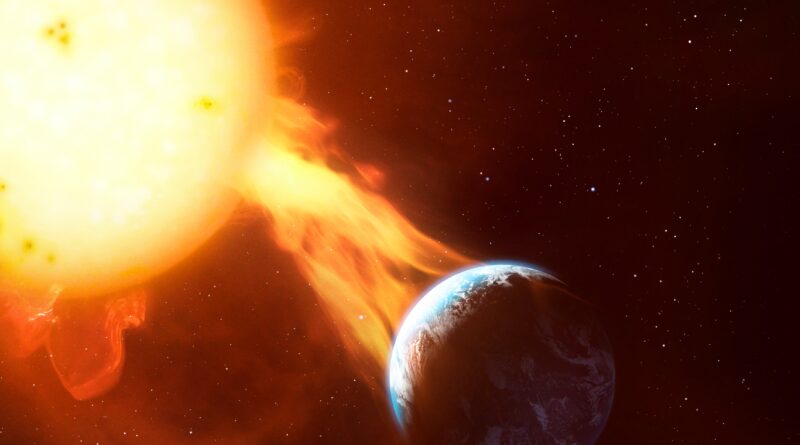
Solar activity has been rising for months, and honestly, scientists knew something was coming, but not quite this soon. The latest update from NASA and NOAA suggests that a new solar storm, stronger than the ones we’ve seen earlier this summer, is now on its way toward Earth. It’s not catastrophic, and nobody is talking about grid failures or apocalyptic scenarios, but it’s unusual enough to make researchers stop what they’re doing and pay attention. The Sun has been behaving in a way that feels slightly ahead of schedule, almost impatient, as if solar maximum is arriving earlier than predicted.
The storm originates from a region called AR 4460, a sunspot cluster that has been crackling with magnetic tension for days. NASA’s Solar Dynamics Observatory captured several mid‑level flares erupting from this area, and one of them released a coronal mass ejection that is now racing toward Earth. The first estimates suggested a slow arrival, but updated measurements from NOAA’s Space Weather Prediction Center show the CME traveling faster than expected, forcing scientists to adjust the arrival window to August 19–20. These changes happen often, but the speed jump caught a few experts off guard.
If the storm hits directly, geomagnetic conditions could reach G2 or even G3 levels. That’s strong enough to produce auroras across Canada, the northern United States, Iceland, Norway, and Sweden. Some researchers say the auroras might dip farther south if the interplanetary magnetic field tilts in the right direction at the last moment. It’s one of those things that’s impossible to predict with certainty, and that’s part of the charm of space weather: even with all our instruments, the Sun still surprises us.
The biggest concern, as usual, is satellite drag. When geomagnetic storms heat Earth’s upper atmosphere, it expands slightly, increasing friction on satellites in low‑Earth orbit. Operators have already been warned to expect mild to moderate drag, which can affect spacecraft like Starlink, Earth‑observation satellites, and older hardware that doesn’t maneuver well anymore. It’s not dangerous, but it requires attention. GPS accuracy might also fluctuate for a few hours, something pilots and survey teams are used to, but still annoying when you’re trying to work.
Interestingly, this storm comes only weeks after another strong event that briefly disrupted radio communications over the Pacific. Pilots reported HF blackouts lasting several minutes, and amateur radio operators noticed unusual propagation patterns. Some researchers think the Sun is entering a more active phase earlier than predicted, though others say this is just normal variability. Solar cycle 25 has been full of surprises, and this storm is just the latest one.
There’s also a growing interest in how these storms affect Earth’s magnetic field long‑term. A few studies published in Nature Astronomy and Space Weather Journal suggest that repeated mid‑level storms might have cumulative effects on satellite orbits and even on atmospheric chemistry. Nothing dramatic, but enough to make scientists rethink how they model long‑term space weather. It’s a field that’s evolving quickly, especially now that we rely on satellites for almost everything, from weather forecasts to internet connections.
For the general public, NASA says there’s no reason for concern. This is not the kind of storm that knocks out power grids or causes major disruptions. It’s more of a scientific curiosity and, for people living in northern latitudes, maybe a chance to see auroras. If the storm intensifies unexpectedly, NOAA will issue updated alerts, but for now the situation is stable.
Still, it’s a reminder that space weather is not just a niche topic for astronomers. It affects navigation, aviation, communications, and even the satellites that monitor climate change. And with solar maximum approaching, we’re likely to see more of these alerts in the coming months. The Sun is waking up, and we’re watching closely.
At the end of this analysis of MoM‑BH*-1, it becomes clear that the early Universe was filled with objects that concealed their true nature behind layers of gas, dust, and gravitational distortion. A similar lesson emerges when looking at long‑term exploration within our own Solar System, especially in the case of Curiosity Rover Wheel Damage, where fourteen years of driving across the Martian surface have left visible scars that tell a story of endurance and engineering resilience.
And while MoM‑BH*-1 pushes our understanding of cosmic dawn, other celestial events closer to Earth continue to remind us how dynamic the sky can be. The upcoming Total Solar Eclipse August 12 2026 will offer a rare moment when the Sun, Moon, and Earth fall into perfect alignment, revealing the solar corona in a way that echoes the luminous envelopes surrounding early black hole stars.
