
Terraforming Mars: 5 Harsh Realities That Keep the Red Planet from Becoming a Second Earth
Terraforming Mars has become one of the most captivating ideas of our time, a scientific and cultural dream that imagines humanity reshaping an entire world. For decades, the Red Planet has carried the promise of a second home, a place with frozen water, mineral‑rich soil, a familiar day‑night cycle and a geological past shaped by rivers and storms.
These features have encouraged generations of scientists, writers and explorers to imagine a future in which Terraforming Mars becomes not just a theoretical exercise, but a genuine attempt to revive a world that once held the potential for life. Yet the closer science looks, the more the illusion dissolves. Mars is not a dormant Earth waiting to be awakened; it is a world that lost its atmosphere, its magnetic shield, its warmth and its biological potential long before humans learned to walk upright. Terraforming Mars means confronting a planet that has forgotten how to sustain itself.
The Temptation of Warming a Dead World
The New Frontier of Climate Engineering
In recent years, the idea of Terraforming Mars has shifted from science fiction to scientific speculation. A study published in Science Advances in 2024 proposed a bold and surprisingly concrete concept: conductive nanoparticles, released into the thin Martian air, could trap heat and raise global temperatures. These particles, built from materials already present on Mars, would act as tiny radiators suspended in the atmosphere, capable of amplifying the greenhouse effect.
The idea resurfaced in 2025 in Nature Astronomy, where researchers argued that engineered climate interventions might warm the planet within decades rather than centuries. It is a remarkable possibility, one that suggests Mars is not as inert as once believed. But warming a planet is not the same as making it habitable. A warm world without air remains a warm vacuum, and Terraforming Mars requires far more than raising the temperature.
The temperature problem is only the first layer of a much deeper challenge. Mars is a cold planet not because it lacks sunlight, but because it lacks the atmospheric density needed to trap heat. Even if nanoparticles could raise the temperature by several degrees, the planet would still lose warmth rapidly into space. Without a thick atmosphere, heat cannot accumulate, water cannot remain liquid and biological processes cannot take root. Terraforming Mars begins with warming the planet, but warming alone cannot sustain life.
The Atmosphere That Isn’t There
A Planet Stripped of Its Breath
Mars once had an atmosphere thick enough to support rivers, lakes and perhaps even oceans. Today, only a ghost remains. Carbon dioxide is trapped in the soil and polar ice, but much of it has been chemically transformed into carbonates over billions of years. Even if all of it were released, the resulting atmosphere would still be too thin to hold heat, liquid water or oxygen. Without a dense sky, Mars cannot shield itself from cosmic radiation or solar wind.
Gas escapes into space, water evaporates almost instantly and molecules break apart under relentless ultraviolet light. The planet cannot keep what we try to give it. And unlike Earth, Mars no longer has a global magnetic field capable of protecting its sky. Its magnetic remnants are local, fragmented and insufficient to preserve an atmosphere.
This is the fundamental difference between the two worlds: Earth protects life because it protects its air. Mars lost that protection long ago. Any attempt at Terraforming Mars must confront this reality. Rebuilding an atmosphere is not simply a matter of releasing gases; it requires restoring the planetary systems that maintain atmospheric stability. Without a magnetic field, Mars will continue to lose gas into space. Without volcanic activity, it cannot replenish what is lost. Without a thick atmosphere, it cannot retain heat. Terraforming Mars means rebuilding a planetary engine that no longer exists.
Biology Meets Its Limits: Oxygen, Radiation and Gravity
The Oxygen Challenge
Even imagining a warmer Mars with a thicker atmosphere, oxygen remains the most stubborn obstacle. Photosynthesis could produce it, but only with vast ecosystems of microbes, algae and plants. A 2025 review in Communications Biology explored the use of extremophiles—organisms capable of surviving in extreme environments—but no one knows whether they could sustain a stable biosphere under Martian conditions. Oxygen is not just a gas; it is the product of a living world.
To create an oxygen-rich atmosphere, Terraforming Mars would require forests, oceans, soil cycles and microbial networks that interact in ways we barely understand. The scale of biological engineering required is immense, and the timescales stretch far beyond human lifetimes.
Radiation and the Underground Refuge
Mars is constantly bombarded by cosmic rays and solar particles. Earth is shielded by both its thick atmosphere and its global magnetic field. Mars has neither. Its surface is hostile to long-term human life, while its subsurface offers a more promising refuge. Beneath the ground, rock layers soften radiation and stabilize temperatures, creating natural shelters where future habitats could be built. The underground may become the first real home for human settlers, not because it is ideal, but because it is the only environment that offers protection from the planet’s harsh sky. Terraforming Mars will likely begin below the surface, not above it.
Gravity and the Unknowns of Human Biology
Martian gravity is only 38 percent of Earth’s. Long-duration missions show that reduced gravity affects bones, muscles, the cardiovascular system and neurological development. No one knows whether humans could live, grow and reproduce for generations under such conditions. Gravity is not a detail; it is a biological foundation. A species adapted to Earth’s gravity may not thrive under a weaker pull, and the long-term consequences remain one of the greatest unknowns in the future of Terraforming Mars and human colonization.
A Patchwork of Habitats Instead of a New Earth
The Most Realistic Future
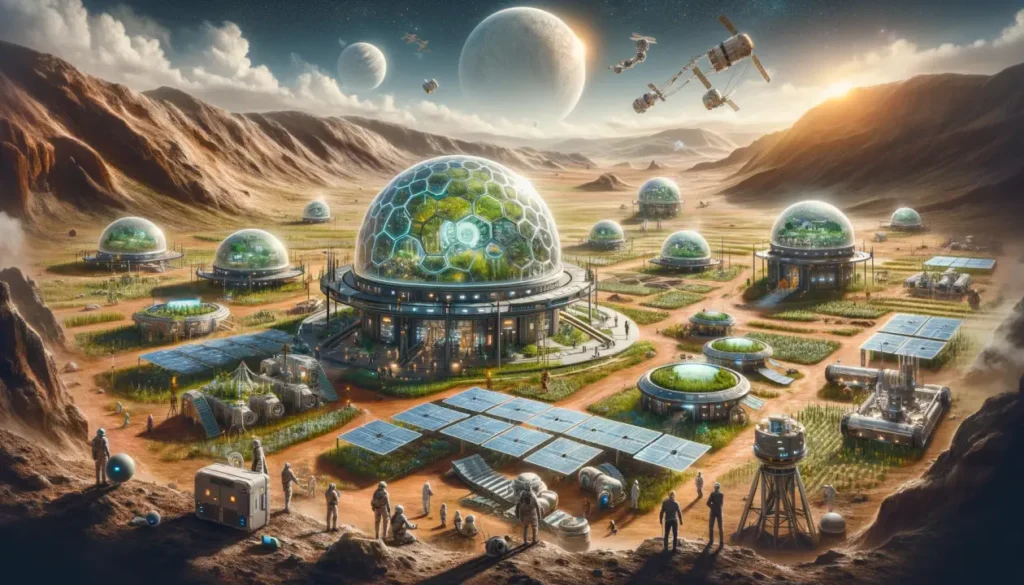
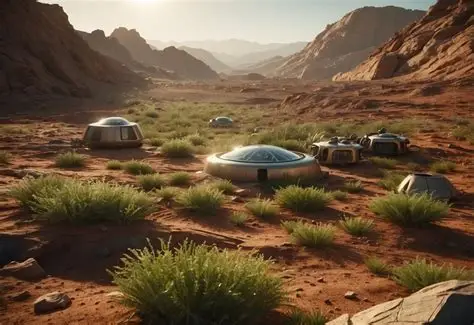
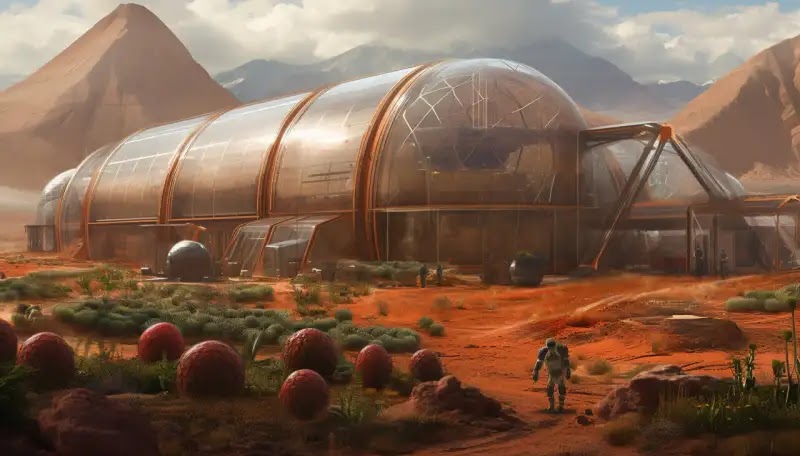
The scientific vision emerging today is not a fully terraformed planet, but a mosaic of controlled environments. Pressurized habitats warmed and shielded from radiation could host water, crops and breathable air. These structures would rely on local resources—ice for water, regolith for building materials, sunlight for energy—and create pockets of life in an otherwise hostile world. It is a future made of small fragments rather than a global transformation, a Mars inhabited in pieces rather than reborn as a second Earth. Terraforming Mars may begin with isolated habitats, not planetary-scale engineering.
This approach resembles the fictional greenhouse seen in The Martian, but grounded in real technologies already under study. It avoids the impossible task of rebuilding an entire atmosphere and focuses instead on creating places where humans can survive, work and explore. Yet even these habitats must confront radiation, nutrient scarcity, water recycling, air regeneration and the unknown effects of long-term life in reduced gravity. Mars may become a place where humans can live. It may host laboratories, farms, underground shelters and small colonies. It may become a world inhabited. But a true second Earth remains far beyond our reach.
The Dream That Persists
The latest research suggests that some steps—especially warming the planet—are less prohibitive than once believed. But the transformation of Mars into a breathable, Earth-like world remains far beyond our capabilities. The Red Planet may welcome us in fragments, in habitats carved from rock and warmed by human ingenuity, long before it ever resembles the world we call home. Terraforming Mars will not turn the Red Planet into Earth. But it may become something else: a frontier where life survives not because the planet allows it, but because humanity insists on creating it.
At the end of this exploration of Terraforming Mars, you can dive deeper into the cosmic forces that shape worlds across the universe. These two investigations expand the journey from planetary engineering to the chemistry of distant atmospheres and the birth of the first cosmic structures.
Exoplanet Atmospheres: Stunning JWST Discoveries Reveal the Chemistry of Distant Worlds
Cosmic Dawn and Reionization: The First Billion Years of the Universe
