
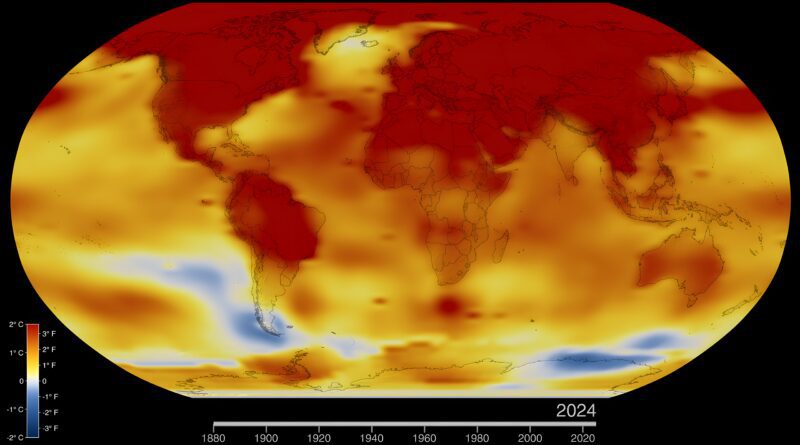
Extreme heat 2026: a dangerous new era of global warming
Extreme heat 2026 has revealed a climate that no longer resembles the one humanity was built for. The summer of 2026 did not simply break records — it exposed the limits of our infrastructure, our health systems, and our assumptions about what global warming would look like.
The summer of 2026 made one thing unmistakably clear: the Earth has crossed a threshold. It wasn’t just a hot season — it was a season that strained hospitals, damaged infrastructure, overwhelmed cities, and forced governments to confront a climate that no longer resembles the one they were built for. Scientific data updated to September 14, 2026 confirms that the planet is entering a climatic zone humanity has never experienced before.
Extreme heat 2026 and the global temperature record
In July, according to the Copernicus Climate Change Service, the global average temperature reached 16.90°C, equivalent to +1.47°C above the 1850–1900 baseline. It wasn’t the hottest month ever recorded — that record still belongs to July 2023 — but it was among the hottest in history. Then came August, and the picture changed again: Copernicus announced that August 2026 was the warmest month ever measured, with a global anomaly of approximately +1.65°C above preindustrial levels. This new record marks a turning point, a new reference for understanding where the planet is heading.
Across Western Europe, heat took on a new, more aggressive form. The continent did not experience five “consecutive” heat waves, as often claimed, but rather an exceptional sequence that began as early as May, with a third and fourth wave striking in rapid succession. France, Spain, and Portugal repeatedly exceeded 40°C, while Spain recorded 61 days of heatwave conditions, the highest number ever observed according to AEMET. Italy, according to the CNR‑IBE, endured its hottest summer since 1950, with an average temperature of 24.3°C.
The consequences were immediate. European health systems reported unprecedented strain. Preliminary estimates based on available national data indicate at least 35,000 excess deaths linked to the heat — a figure not issued as a definitive WHO number, but drawn from national statistical analyses and independent evaluations reported by major international outlets. The WHO, for its part, confirmed that by July nearly 10,000 excess deaths had already been recorded in just five countries, and that Europe is warming at roughly twice the global average rate.
The heat of 2026 was not an isolated event. On September 3, the World Meteorological Organization confirmed that El Niño is fully established and is expected to intensify into a very strong event, with a near‑100% probability of persisting through February 2027. It is not accurate to call it “the strongest in a thousand years,” but it is accurate to say that its intensification, combined with human‑driven warming, is pushing global temperatures toward new records. Scientists consider it highly plausible that 2027 could become the warmest year ever recorded, though this remains a forecast, not an observed fact.
The real challenge, however, is not just the temperature — it is the world’s ability to adapt. After the catastrophic summer of 2003, when around 70,000 people died across Europe, many countries built heat‑response systems: national plans, cooling centers, protocols for elderly care. France became a model, with measures that significantly reduced heat‑related mortality. But today, with the planet already at +1.45°C over the past twelve months, those systems are showing their limits.
Heat waves now arrive outside traditional seasons, strike with unprecedented intensity, and exceed the thresholds for which early‑warning systems were designed. Kristie Ebi, professor of global health and author of the latest United Nations report, explained that several of the 2026 heat waves surpassed the operational parameters of European alert systems. Temperatures were simply too high. Ebi also noted that, at the current pace of adaptation, countries will only be able to prevent about 10% of expected heat‑related deaths in the coming years.
The human body is also not built for this new kind of heat. Recent scientific research does not identify a universal danger threshold at 26°C, but instead focuses on wet‑bulb temperature, which combines heat and humidity. Studies published in Science Advances and Nature Climate Change show that the body’s ability to cool itself can collapse at values far below the theoretical 35°C limit, especially under high humidity, direct sunlight, low wind, and individual vulnerability. There is no single number — only a rising risk that begins much earlier than previously assumed.
The new UNEP report, released on September 2, 2026, confirms that the world will surpass the 1.5°C threshold in the coming years and that even in the most optimistic scenario, global warming could peak at around 1.8°C. This does not mean that everything becomes irreversible at that level, but it does mean that the likelihood of crossing climatic tipping points increases, and that impacts intensify with every fraction of a degree.
Preparing for the future requires imagination, not just reaction. Scientists are urging governments to stress‑test their cities, much like banks stress‑test financial markets. It means asking what happens when a city faces conditions it has never seen before — as Portland did in 2021, when temperatures reached 46.7°C. Infrastructure buckled, electrical cables melted, and transportation services were suspended. It wasn’t a movie scene; it was a preview of what could happen elsewhere.
The world is not ready. Infrastructure is not ready. Health systems are not ready. Cities are not ready. And neither are our habits, still tied to a climate that no longer exists. Extreme heat is not a temporary phenomenon. It is the new face of Earth’s climate. And while governments debate targets, thresholds, and percentages, reality is advancing faster than any political plan. The question is no longer how to avoid extreme heat, but how to survive in a world that is becoming hotter than we ever imagined.
As scientists examine the full impact of Extreme heat 2026, it becomes clear that this summer was not an isolated anomaly but part of a broader pattern of environmental instability. A deeper exploration of these warning signs can be found in Mass Extinction: When the Planet Starts Sending Warnings in 2026, a report that traces how the planet’s signals have intensified long before this record‑breaking heat arrived.
The unprecedented temperatures of 2026 did not emerge in a vacuum. They were preceded by months of shifting environmental indicators — melting glaciers, collapsing river systems, and ocean anomalies. These signals are explored in When the Planet Starts Sending Warnings: The New Environmental Signals Reshaping 2026, a detailed look at how the Earth began reshaping itself even before the summer’s extreme heat took hold.
By Aria Lorne
