
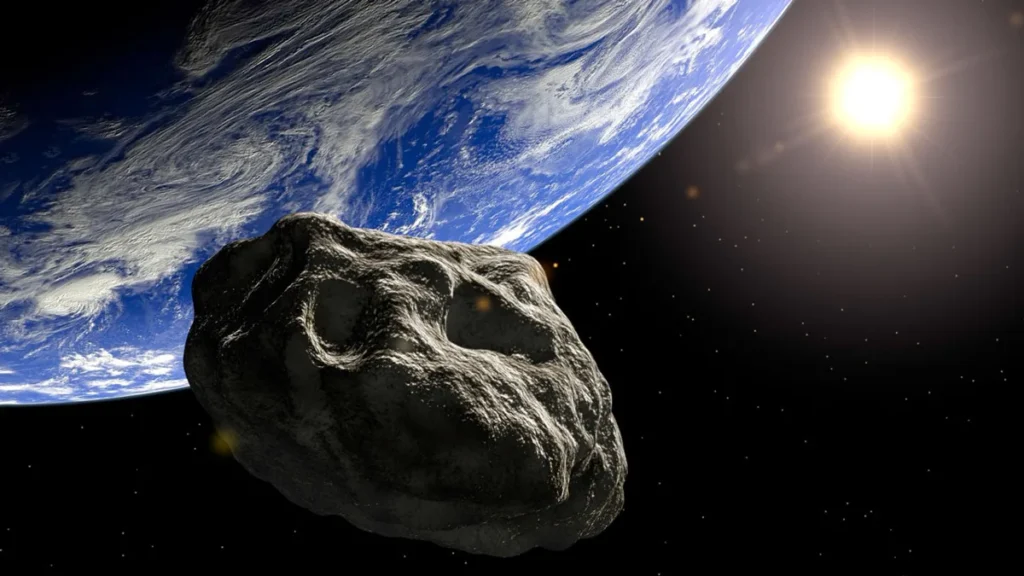
Asteroid Bennu: Why NASA Warns About a Possible Impact in 2182
By Bernardin Moreardino
Asteroid Bennu is not just another near‑Earth object drifting through the Solar System. It is a carbon‑rich relic from the dawn of planetary formation, a body that NASA has monitored for years due to a small but measurable chance of impacting Earth in the distant future.
For decades, humanity has looked at the sky with a mixture of curiosity and unease. Comets have inspired myths, shooting stars have carried wishes, but asteroids — those ancient fragments of the early Solar System — remind us that Earth is not an isolated island drifting safely through space. Among them, one has captured NASA’s attention more than most: Bennu, a dark, carbon‑rich body as old as the birth of the planets, capable — at least in theory — of altering the trajectory of our civilization.
NASA has monitored Bennu for years. It studies it, measures it, analyzes its composition, and constantly updates its orbital predictions. Not out of sensationalism, but for a far simpler reason: Bennu is one of the few asteroids classified as potentially hazardous. Not because it is destined to strike Earth, but because its orbit, over the course of centuries, could intersect ours.
The date that has captured public imagination is September 24, 2182. On that day, according to the most updated models, there is a probability of 1 in 2,700 — about 0.037% — that Bennu could impact Earth. It is an extremely low risk, almost negligible, yet significant enough to justify continuous monitoring. Because when it comes to asteroids, even a tiny probability can become a planetary concern.
An ancient traveler that brushes past Earth every six years
Bennu is not a sudden intruder. Its orbit brings it close to Earth roughly every six years, a steady rhythm that allows scientists to track it with increasing precision. With a diameter of about 500 meters and an estimated mass of 74 million tons, Bennu is large enough to cause catastrophic regional damage, but not large enough to trigger a global extinction event like the one that wiped out the dinosaurs.
Its composition makes it even more intriguing: Bennu is rich in carbon, water, and organic compounds considered essential for the origin of life. It is a cosmic archive, a fragment of the chemical history of the Solar System — a piece of what existed before Earth became Earth.
This primordial nature is precisely what drove NASA to launch one of the most ambitious missions in its history: OSIRIS‑REx.
OSIRIS‑REx: the mission that touched an asteroid and brought its memory back to Earth
On September 8, 2016, a spacecraft left Earth with an objective that once belonged to science fiction: reach Bennu, study it up close, collect samples from its surface, and return them home. Four years later, on October 20, 2020, OSIRIS‑REx performed its boldest maneuver — a brief touch‑and‑go that vacuumed ancient dust and rock fragments from Bennu’s surface.
On September 24, 2023, the sample capsule re‑entered Earth’s atmosphere, landing in Utah. Inside were 121.6 grams of material — more than double the mission’s minimum target. A tiny amount, yet enough to rewrite entire chapters of our understanding of primordial bodies.
Thanks to these samples, scientists analyzed Bennu’s chemical composition with a precision impossible through remote observations. They confirmed the presence of organic molecules, hydrated minerals, and traces of chemical processes that may have played a role in the origin of life on Earth.
But OSIRIS‑REx did more than collect material. It measured the subtle forces that slowly alter Bennu’s orbit, such as the Yarkovsky effect — a tiny push caused by the heat the asteroid emits into space. These measurements reduced orbital uncertainty and improved long‑term predictions.
The 2135 flyby: the moment that could change everything
The real turning point is not 2182. It is September 25, 2135.
On that date, Bennu will pass close to Earth in an encounter that could alter its orbit. Not an impact, but a gravitational interaction capable of shifting its trajectory.
Scientists are studying a narrow region of space known as a gravitational keyhole. If Bennu were to pass through this tiny corridor, Earth’s gravity could redirect it onto a path that increases the probability of a future impact.
The likelihood remains extremely low — but not zero. And that is enough to keep NASA’s attention sharp.
What would happen if Bennu struck Earth?
Recent computer simulations have examined the consequences of an impact from an asteroid the size of Bennu. The results are clear: it would not be a global extinction event, but it would be devastating.
A 500‑meter impactor would generate:
• a shockwave capable of destroying everything within tens of kilometers • wildfires across a vast region • earthquakes and ground vibrations • a massive crater several kilometers wide • between 100 and 400 million tons of dust injected into the atmosphere
And it is this dust that poses the greatest threat.
According to scientist Lan Dai, the sunlight blocked by the dust would trigger a sudden “impact winter” — a period of global cooling, reduced solar radiation, decreased precipitation, and a temporary collapse of photosynthesis.
Simulations indicate:
• a drop in global average temperature of about 4 °C • a 15% reduction in precipitation • a 20–30% decline in photosynthesis • a 32% thinning of the ozone layer
It would not end civilization, but it would be a planetary crisis.
Why NASA continues to monitor Bennu
The answer is simple: because prevention is possible.
Unlike terrestrial natural disasters, an asteroid impact can be avoided decades in advance. Deflection technologies — such as the kinetic impact tested by NASA’s DART mission in 2022 — can alter an asteroid’s trajectory with a minimal push, provided it is applied early enough.
Monitoring Bennu ensures that humanity has the time and knowledge to act if necessary.
It also deepens our understanding of NEAs — Near‑Earth Asteroids — and improves our ability to predict future risks.
OSIRIS‑APEX: the journey continues
After completing its primary mission, OSIRIS‑REx was renamed OSIRIS‑APEX and sent toward another asteroid: Apophis, which will pass extraordinarily close to Earth in 2029 — just 32,000 kilometers away.
Apophis does not pose an impact risk, but its flyby offers a rare opportunity to study an asteroid during a near‑Earth encounter. OSIRIS‑APEX will analyze its surface, composition, and orbital dynamics.
It is another step toward building a planetary defense strategy based on knowledge, not fear.
Bennu and the future of planetary security
The story of Bennu is not a story of alarm. It is a story of preparation.
The probability of an impact in 2182 is tiny, but continuous monitoring allows NASA to refine models, reduce uncertainty, and ensure that if a real threat ever emerges, humanity will have the time and technology to respond.
Bennu is a reminder that we live in a dynamic universe, where Earth is not a fixed point but a body moving through a sea of cosmic debris. Studying these objects means protecting our future.
It also means understanding our past, because asteroids like Bennu are natural archives of the chemical history that led to life.
Conclusion: a century of observation for a minimal but real risk
2182 is distant. 2135 is less distant. And OSIRIS‑REx has already changed how we understand Bennu.
Science does not seek to frighten. It seeks to foresee. And in this case, the forecast is clear: the risk is low, but the knowledge is high. And knowledge is what allows civilization to prepare, protect itself, and understand its place in the cosmos.
Bennu is not an enemy. It is a messenger — a fragment of what we once were, and a reminder of what we may become.
At the edge of every astronomical story, there is always another object waiting to challenge our understanding of the cosmos. If the journey through asteroid Bennu has revealed how fragile Earth’s long‑term safety can be, the next step is to look beyond our Solar System, toward something even more mysterious. The exploration continues with 3I/ATLAS — Scientific Analysis of a Potential Interstellar Comet, an interstellar visitor racing through space with a trajectory that defies the boundaries of our Sun’s gravitational reach.
