
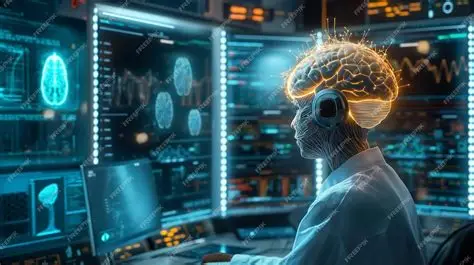
Brain‑Computer Interfaces: When the Brain Starts Talking to the Machine
Brain‑computer interfaces are transforming the way the brain communicates with the world, revealing something strangely intimate about controlling a computer without touching it.
There is something deeply human in the idea of directing a machine with nothing but neural activity… There is something strangely intimate about the idea of controlling a computer without touching it. No mouse. No keyboard. No movement of the hand. Just a thought.
For years, this sounded like science fiction. Today, it is becoming a very real area of neuroscience, and the most important part of the story is not really about computers. It is about people who have lost the ability to move or speak and are slowly being given another way to communicate with the world.
Brain-computer interfaces, usually called BCIs, work by recording electrical activity generated by the brain and translating it into commands. In simple terms, the system tries to understand what the brain is attempting to do and turn that intention into an action on a computer or another device.
The technology is still young, complicated and far from perfect. But something changed recently. Researchers are beginning to show that these systems can move beyond the laboratory.
A study published in Nature Medicine in June 2026 described the long-term independent use of an intracortical BCI by a man living with paralysis and severe dysarthria caused by amyotrophic lateral sclerosis, or ALS. The system combined brain-to-text speech decoding with control of a computer cursor, allowing the participant to use it independently at home on a near-daily basis.
That detail — independently, at home — may actually be more important than the technology itself.
Laboratories are controlled environments. There are researchers nearby, computers everywhere, cables, technicians and someone ready to intervene when something stops working.
Real life is different.
Real life is a bedroom at eight in the morning. A conversation with a family member. A message someone wants to write. A television that needs to be controlled. A moment when nobody is standing over your shoulder waiting to collect data.
For a brain-computer interface to become genuinely useful, it has to survive that world. And that is where the field is beginning to move.
The goal is no longer simply to demonstrate that brain activity can control a cursor for a few minutes. Researchers are increasingly interested in systems that remain useful over long periods and can become part of a person’s everyday routine.
That shift sounds technical, but it changes the meaning of the technology.
If someone who cannot move their hands can control a cursor with brain activity, the achievement is not really that the cursor moved. The achievement is that the person regained a small piece of independence. There is another direction that may be even more remarkable.
Researchers are beginning to work on systems that do not only take information out of the brain. They also try to send information back in.
In August, Nature Neuroscience highlighted research involving a double neural bypass system designed to restore both movement and sensation in a person with chronic tetraplegia. Neural signals from the motor cortex were used to control electrical stimulation that produced voluntary hand movements, while sensors on the hand supplied information that was converted into stimulation of the somatosensory cortex.
In other words, the researchers were trying to close the loop. The brain tells the machine what the person wants to do. The machine helps the body move. And then information about what happened is sent back toward the brain. That last part is crucial.
Movement without sensation is not the same thing as natural movement. If you pick up a cup, for example, you do not need to consciously calculate how much pressure your fingers should apply. Your nervous system is constantly receiving information from your skin, muscles and joints.
The cup feels heavy or light. The surface feels smooth or rough. You know when your grip is too strong. You know when it is slipping. All of this happens so quickly that we rarely think about it.
A neuroprosthetic system that wants to feel natural has to somehow deal with that same complexity. This is why the future of BCIs may not simply be about reading the brain.
It may be about creating a conversation between brain, body and machine. There is another problem that researchers are still trying to solve: learning.
A BCI does not automatically understand every person’s brain. The user often has to learn how to control the system, while the system has to learn how to interpret the user’s neural activity.
A study published in Nature Neuroscience in June 2026 looked at this problem using a non-invasive brain-computer interface. Researchers found that people’s ability to learn BCI control was influenced by the natural geometry of their brain activity — what neuroscientists describe as the intrinsic neural manifold. When the system’s mapping followed these natural patterns, participants were able to learn control more successfully.
It is a fascinating idea.
Perhaps the best interface is not the one that forces the brain to adapt to a machine. Perhaps it is the one that learns how the brain already wants to work. That could become one of the central principles of future neurotechnology. At the same time, the field is becoming increasingly competitive.
Neuralink is expanding clinical research into its implantable system, while other companies and research groups are developing different approaches. Some systems place electrodes inside the brain, others use interfaces on the surface of the brain, and non-invasive systems attempt to obtain useful signals without surgery.
There is no single winning technology yet. And that is probably a good thing. The brain is too complicated for a simple technological race.
There are still questions about how long implants can remain reliable, how neural signals change over time, how devices should be maintained and what happens when the technology becomes part of a person’s life for years rather than months.
Then there are the questions that cannot be solved by better engineering. Who owns neural data? Who should be allowed to access it?
What happens if a system can infer something about a person’s intentions that they did not deliberately communicate?
And perhaps the strangest question of all: where exactly does the person end and the machine begin? These questions are no longer entirely philosophical. China has already approved a brain implant for people with severe paralysis that allows users to control a soft robotic hand, marking a significant step toward clinical use of BCI technology outside research trials.
Meanwhile, researchers in the United States and elsewhere are continuing clinical studies of implanted systems aimed at restoring communication and movement.
The technology is moving forward.
But the most interesting part may be that the closer we get to making machines communicate with the brain, the more we are forced to understand how extraordinary ordinary human communication really is.
Speaking to another person seems effortless. Moving a hand seems effortless.
Picking up a cup, typing a sentence, turning your head toward a voice — most of the time, we never stop to think about what the nervous system is doing underneath it all.
Until those abilities disappear. Then every small action becomes enormous. A cursor moving across a screen can become a voice. A robotic hand can become a form of independence. A few words produced from neural activity can mean being able to tell someone you love them. That may be the real promise of brain-computer interfaces. Not creating superhumans.
Not replacing the brain. And not turning science fiction into reality simply because we can. For now, the most meaningful achievement is much simpler.
Helping someone communicate when their body no longer allows them to. The machine is only the bridge. The message still belongs to the human being.
If you want to explore another early biological signal of Alzheimer’s, you can read Elen Hartley’s investigation into early activated microglia, the first brain cells to sense that something is going wrong long before symptoms appear.
For a broader view of early detection, the Media Creation team’s analysis on blood biomarkers for Alzheimer’s reveals how subtle molecular changes in the bloodstream may expose the disease years before traditional imaging detects it.
