
The Astonishing Reality of Mercury Shrinking and the Dramatic Transformation Scientists Nearly Missed
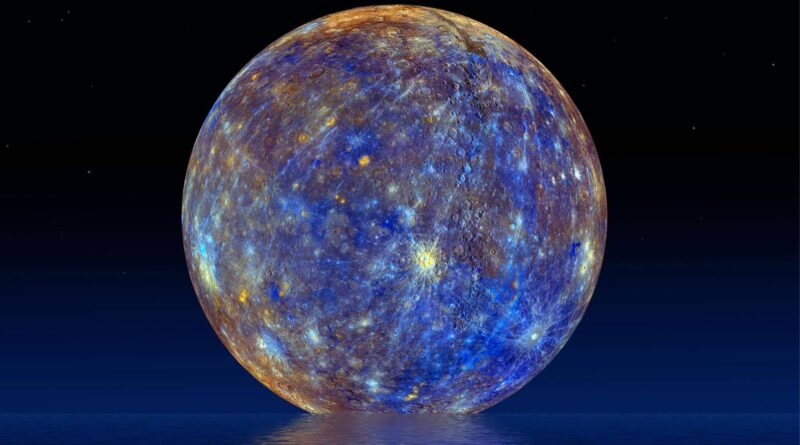
Mercury shrinking is one of those ideas that seems almost unbelievable the first time you hear it. I remember the moment I realized that the smallest planet in our Solar System has been slowly tightening, almost like a fist closing over unimaginable stretches of time. Mercury looks like a gray, cratered sphere that has already told its story, but according to new research, its history is far more dynamic than its appearance suggests.
Scientists have known for decades that Mercury has been contracting as its interior cools, but they never had a precise measurement of how much the planet has actually shrunk since it formed around 4.5 billion years ago. Now, a new study suggests that the contraction may be significantly larger than previously believed, reaching up to twenty‑three kilometers in diameter. When I saw that number, I felt a strange mix of awe and curiosity, because twenty‑three kilometers is not a detail; it is a transformation.
Mercury Shrinking and the Hidden Evidence Beneath Its Impact‑Scarred Surface
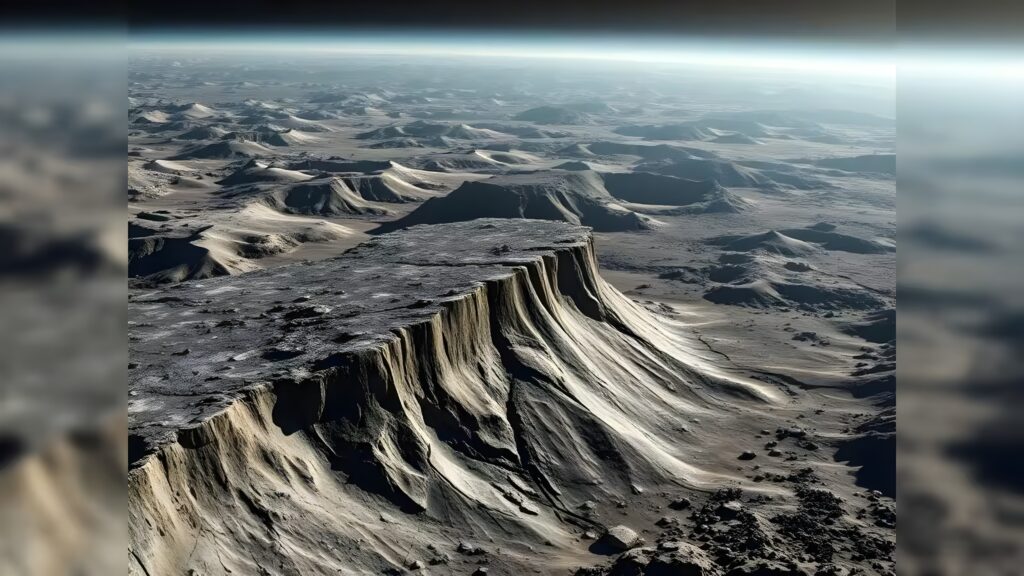
The reason Mercury shrinking happens is deeply connected to what lies beneath its battered exterior. Mercury has an unusually large iron‑rich core compared to its overall size, and when the planet formed, that core was far hotter than it is today. Over billions of years, that heat has slowly escaped into space. As the core cools, it contracts, and the rocky outer shell must respond to that change. Instead of thinning uniformly, the crust compresses and folds, creating enormous cliffs, ridges, and faults that scientists often describe as the planet’s wrinkles. I think there is something almost poetic about imagining a world slowly tightening as its internal fire fades, leaving geological fingerprints across its surface.
But Mercury’s surface complicates everything. It is covered with impact craters, some of them enormous. Every major impact blasts rock and dust across the landscape, burying older structures. Over geological time, those deposits accumulate, hiding the very features scientists need to measure the planet’s contraction. The researchers behind the new study looked for a relationship between the geological features associated with contraction and the roughness of Mercury’s surface.
What they found was intriguing: the roughest areas tended to show fewer visible signs of contraction. At first, that might suggest those regions simply experienced less shrinking, but the scientists believe the opposite is true. The contraction features are probably still there, just buried beneath material produced by impacts. When I read that, I thought it made perfect sense. The missing wrinkles aren’t missing; they’re hidden.
How Mercury Shrinking Changes Our Understanding of the Planet’s Geological History
This discovery changes the way scientists estimate Mercury’s past. If researchers count only the contraction features that remain visible, they risk underestimating how much the planet has actually shrunk. The new study compensates for those obscured areas and arrives at the estimate suggesting that Mercury may have lost as much as twenty‑three kilometers of diameter since its formation. That does not mean every part of Mercury moved inward by the same amount.
Planetary contraction is complicated, and different regions have experienced different geological histories. But the overall picture is important. It suggests that Mercury’s interior may have undergone more substantial cooling and contraction than previous calculations indicated. And I think that is one of the most fascinating aspects of this story: a planet that looks frozen and silent is still revealing new layers of its past.
Why Mercury Shrinking Matters for Understanding the Planet’s Iron‑Rich Core
At first glance, the question of Mercury shrinking might seem like a curiosity. After all, Mercury has been contracting for billions of years. Whether the total contraction is a little smaller or larger may not appear particularly important outside planetary science. But the amount of contraction tells scientists something essential about what is happening inside the planet. Mercury’s enormous metallic core is one of its defining characteristics. Understanding how that core has cooled over time helps researchers reconstruct the planet’s thermal evolution.
The surface is effectively a record of that history. Every scarp, ridge, and fault provides another clue. If scientists can determine when those structures formed and how much the planet contracted, they can build better models of how Mercury’s interior changed over billions of years. And Mercury is not necessarily an isolated case. Other rocky planets and moons also cool and evolve internally. Studying Mercury gives researchers another example of how a small rocky world changes after its formation.
What BepiColombo Could Reveal About Mercury Shrinking and the Planet’s Future
Mercury has already been visited, but only briefly. The first spacecraft to explore it was NASA’s Mariner 10, which flew past the planet several times during the 1970s. Mariner 10 changed our understanding of Mercury, revealing a heavily cratered world with a surprisingly complex geological history, but it photographed only part of the planet. Decades later, NASA’s MESSENGER mission provided a much more complete survey.
It entered orbit around Mercury in 2011 and spent several years studying the planet before deliberately crashing into its surface in 2015. MESSENGER mapped Mercury in unprecedented detail, and much of what scientists know today about the planet’s geology comes from those observations. But even MESSENGER could not answer every question. There are still uncertainties about how Mercury evolved, how much its interior has cooled, and exactly how much its surface has contracted.
That is why the timing of the new study is particularly interesting. The European Space Agency and the Japan Aerospace Exploration Agency’s BepiColombo mission is on its way to Mercury. The spacecraft was launched in 2018 and has spent years using carefully planned trajectories and planetary flybys to reach its destination. Once it begins its full mission around Mercury, scientists will have an opportunity to examine the planet with instruments that can reveal details unavailable to previous missions.
BepiColombo consists of two scientific orbiters, one developed by Europe and the other by Japan. Together, they will study Mercury’s surface, interior, magnetic environment, and interaction with the solar wind. One particularly useful instrument is a laser altimeter, which can measure variations in the planet’s terrain. That could provide an important test of the new shrinking estimate. Gaku Nishiyama, the lead author of the study, is also involved with BepiColombo.
He has suggested that the spacecraft’s measurements could help determine how closely the new calculations match Mercury’s actual geological history. There is even a possibility that the final answer could point to an even greater amount of contraction. When I imagine that, I feel the same curiosity that made me fall in love with astronomy in the first place.
Mercury Shrinking as a Window Into How Rocky Worlds Evolve Over Billions of Years
There is something almost deceptive about Mercury’s appearance. The planet looks ancient. Its surface is dominated by craters that have survived for enormous periods of time, and from photographs it can seem like a world where geological activity ended long ago. But that impression is misleading. Mercury is still changing. Its interior continues to lose heat. Its crust continues to bear the consequences of that cooling.
The changes are far too slow for a human observer to notice, but they are written into the planet’s landscape. The irony is that some of those records have also been damaged by the very process that makes Mercury so interesting. Asteroid impacts have repeatedly covered, broken, and reshaped the surface, making it harder for scientists to reconstruct what happened in the distant past. It is a little like trying to read an ancient manuscript that has been repeatedly scratched, folded, and covered with new writing. Researchers have to work out which marks are original and which came later.
BepiColombo could make that reconstruction considerably easier. As the mission begins its detailed observations, scientists will have access to new measurements of Mercury’s topography and gravitational field. Those observations should help refine models of the planet’s interior and provide a better understanding of the forces that have shaped its surface.
For now, the twenty‑three‑kilometer estimate should be viewed as a scientific estimate rather than the final word. The researchers themselves acknowledge that Mercury’s geological history is more complicated than any single number can describe. Still, the possibility that the planet has contracted around thirty percent more than previously thought is significant. It suggests that scientists may have underestimated just how dramatically Mercury has changed since the early Solar System.
And perhaps that is the most fascinating lesson here. Mercury may be tiny, but its history is enormous. For 4.5 billion years, the planet has been slowly cooling, contracting, and reshaping itself while asteroids continually battered its surface. Much of that story is still hidden beneath the scars. Now, with a new generation of observations approaching Mercury, scientists may finally be able to see more clearly how much this little world has really shrunk — and what that shrinking tells us about the planet hiding beneath its wrinkled exterior.
At the end of Mercury’s long story of cooling and contraction, it’s impossible not to look outward and notice how the universe keeps surprising us. One of the most striking examples is the distant high‑energy beacon known as OP 313 blazar, a source so remote and intense that it feels like a message from the early cosmos. You can explore its discovery here: OP 313 blazar.
And while Mercury shrinks in silence, another mission prepares to redraw our cosmic map entirely. NASA’s Roman Space Telescope is heading toward L2 to observe the universe with unprecedented depth and clarity, a launch that marks a turning point in modern astronomy. You can read more about that moment here: Roman Space Telescope launch.
