
Roman Space Telescope Launch: The Morning NASA Decided to Redraw the Universe
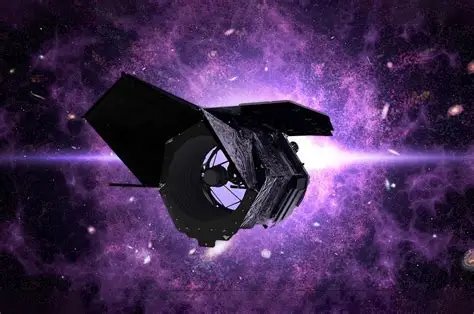
Roman Space Telescope launch — On the morning of August 30, 2026, NASA ignited one of the most ambitious scientific missions of the decade as the Nancy Grace Roman Space Telescope lifted off aboard a SpaceX Falcon Heavy, beginning its journey toward Lagrange Point L2, 1.5 million kilometers from Earth.
There are mornings in the history of space exploration that feel different from all the others. Mornings in which the countdown is not just a technical ritual, but the final breath before a new chapter begins. The dawn of August 30, 2026, at the Kennedy Space Center, was one of those mornings. At 7:26 a.m., under the pale Florida sky, the Nancy Grace Roman Space Telescope rose on the shoulders of a SpaceX Falcon Heavy, carrying with it decades of scientific ambition, political negotiation, engineering refinement, and the quiet hope that humanity might finally understand something deeper about the Universe.
The rocket climbed, the engines roared, and the ground trembled. But the true moment — the one that will be remembered — came minutes later, when Roman separated cleanly from the upper stage and began its solitary journey toward Lagrange Point L2, a gravitational sanctuary 1.5 million kilometers from Earth. It is there, in that delicate balance between the Sun and our planet, that Roman will spend the next decade observing the cosmos with a breadth and speed no telescope has ever possessed.
A Mission Built on Immensity
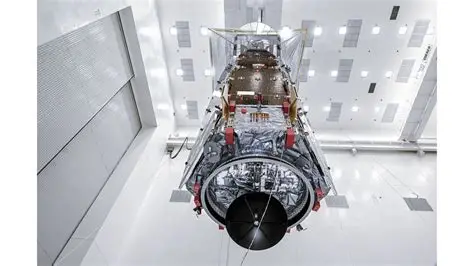
Roman is not a successor to Hubble, nor a competitor to the James Webb Space Telescope. It is something else entirely — a machine built to see more, not necessarily deeper. Its 2.4‑meter primary mirror mirrors Hubble’s dimensions, but the similarity ends there. Roman’s Wide Field Instrument offers a field of view 100 times larger than Hubble’s, and NASA estimates it will survey the sky up to 1,000 times faster.
This combination — Hubble‑class resolution with panoramic vision — is unprecedented. It means Roman will not simply capture beautiful images; it will map the Universe. Not a corner of it, not a slice, but a statistically meaningful portion of the cosmos itself.
During its mission, Roman is expected to measure the light of around one billion galaxies. A billion. Enough to reconstruct the cosmic web with a clarity that transforms abstract theory into visible structure. Enough to trace how matter has flowed, clustered, collapsed, and expanded over billions of years. Enough to confront the deepest mysteries of cosmology with data so vast that it will take generations to fully analyze.
The Dark Energy Enigma
At the heart of Roman’s mission lies a question that has haunted astrophysics for a quarter of a century: Why is the Universe expanding faster than it should?
Astronomers call the unknown force behind this acceleration dark energy, but the name is little more than a placeholder for ignorance. They know the effect; they do not know the cause. Roman will attempt to change that.
By observing billions of galaxies and measuring how they cluster and stretch across cosmic time, Roman will test whether dark energy is:
- a constant property of space,
- or a dynamic phenomenon that has evolved over the history of the Universe.
This distinction is not academic. It determines the fate of the cosmos. A constant dark energy leads to eternal expansion; a changing one could mean something far stranger — a Universe that accelerates, slows, or even tears itself apart.
Roman’s wide‑field surveys will allow scientists to compare different cosmological models with unprecedented precision. It will refine our understanding of gravity, matter, and the geometry of spacetime itself. In a sense, Roman is not just observing galaxies; it is observing the rules that govern reality.
Mapping the Invisible Universe
Dark energy is only half the mystery. Roman will also investigate dark matter, the invisible substance that shapes galaxies and cosmic structure. Dark matter does not emit light, but its gravitational influence is unmistakable. It bends the paths of stars, distorts the shapes of galaxies, and sculpts the cosmic web.
Roman’s billion‑galaxy survey will allow astronomers to map dark matter with a detail never achieved before. By studying how galaxies cluster and how gravity warps light across vast distances, Roman will produce a portrait of the Universe’s skeleton — the hidden architecture beneath everything we see.
A Census of New Worlds
Roman’s ambitions are not limited to the distant Universe. It will also turn its gaze toward our own galaxy, searching for exoplanets using gravitational microlensing. This technique detects planets when their gravity briefly magnifies the light of a distant star. It is subtle, rare, and extraordinarily powerful.
Because Roman can observe enormous regions of the Milky Way at once, it will conduct a statistical census of planetary systems across our galaxy. It will not just find planets; it will reveal how common they are, how they form, and how they evolve. It will help answer one of humanity’s oldest questions: How many worlds are out there?
On board Roman is also the Coronagraph Instrument, a technological experiment designed to block starlight and directly image extremely faint exoplanets — potentially up to one billion times dimmer than their host stars. If successful, this technology will pave the way for future missions capable of imaging Earth‑like planets around Sun‑like stars.
Engineering a Lightweight Giant
Roman’s mirror is a triumph of modern engineering. Although it shares Hubble’s diameter, it weighs only 186 kilograms, roughly 80% lighter than Hubble’s mirror. This dramatic reduction is the result of decades of innovation in materials and manufacturing. Roman is, in many ways, a symbol of how far space telescope engineering has come.
The Journey to L2
Roman will spend about three months traveling to L2. During this time, mission controllers will activate and test its systems, ensuring that every component is ready for the scientific phase. The successful separation from Falcon Heavy and the establishment of communications were only the first steps in a long commissioning process.
Once Roman reaches L2, it will enter a stable orbit where sunlight, Earthlight, and moonlight are minimized — ideal conditions for infrared observations.
A Mission with a Legacy
Before becoming the Roman Space Telescope, the mission was known as WFIRST (Wide Field Infrared Survey Telescope). It now honors Nancy Grace Roman, NASA’s first chief astronomer and one of the key figures behind the agency’s space‑based astronomy program. Roman played a crucial role in making Hubble possible, and naming the new telescope after her reflects her lasting impact on astrophysics.
Roman, Hubble, and Webb: Three Visions of the Universe
Hubble showed us the beauty of the Universe in unprecedented detail. Webb pushed deeper into the infrared, revealing the earliest galaxies. Roman will take a panoramic approach, surveying enormous swaths of the sky to build datasets that will fuel scientific research for decades.
Roman is not designed to answer a single question — it is designed to answer many, simultaneously.
A New Era Begins
The launch of August 30 marks the beginning of a new chapter in space astronomy. As Roman travels toward L2 and scientists prepare for the first observing campaigns, expectations are immense. By mapping billions of galaxies and millions of stars, Roman may help answer one of cosmology’s most profound questions:
not just how the Universe is structured, but why it behaves the way we observe today.
While Roman prepares to map the distant Universe, it’s worth remembering that some of the most intriguing mysteries lie much closer to home. On Mars, the Curiosity rover has uncovered more than twenty organic molecules preserved inside ancient clay deposits — compounds that shouldn’t exist in such a harsh environment and yet persist like chemical fossils of a forgotten era. These findings continue to reshape our understanding of Mars’ past and the potential complexity of its early chemistry. You can explore the full story here: Organic Molecules on Mars.
At the same time, while Roman heads toward L2 to observe the cosmos with unprecedented clarity, our own star reminds us how dynamic and unpredictable the Solar System can be. In August 2026, NASA confirmed a powerful solar storm triggered by an incoming CME, a burst of solar plasma capable of disturbing Earth’s magnetic field and igniting auroras across northern latitudes. It was a vivid demonstration of why monitoring solar activity remains essential for both science and technology. You can read the detailed update here: Solar Storm August 2026.
