

OP 313 blazar: the most distant high‑energy source ever detected
The OP 313 blazar stands out not only for its extreme distance but also for the clarity with which its gamma rays reveal the structure of relativistic jets and the density of the extragalactic background light. Its detection marks a milestone for instruments like LST‑1 and MAGIC, which together have pushed the frontier of high‑energy astrophysics deeper into the early Universe.
A signal coming from approximately 8 billion light-years away has allowed astronomers to observe one of the most extreme objects in the Universe. It is OP 313, a blazar powered by a supermassive black hole, which has become the most distant blazar ever detected at very high energies.
The result was achieved by combining observations from the LST-1 telescope, the prototype of the Large-Sized Telescopes planned for the future Cherenkov Telescope Array Observatory (CTAO), with observations from the two MAGIC telescopes at the Roque de los Muchachos Observatory on the island of La Palma, in the Canary Islands. The study was published in Astronomy & Astrophysics in August 2026.
A Journey Back Through the History of the Universe
OP 313 has a redshift of 0.997, corresponding to a distance of approximately 8 billion light-years. This means that the radiation we are detecting today began its journey toward Earth when the Universe was much younger than it is now.
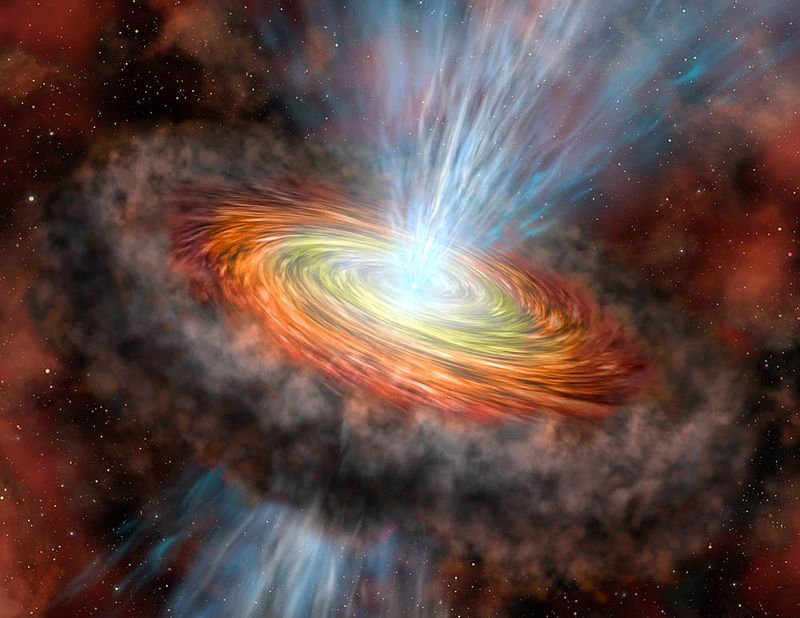
The source is a Flat Spectrum Radio Quasar (FSRQ), a particular class of active galactic nucleus. At the center of these systems lies a supermassive black hole surrounded by matter falling into it. Part of the energy released by this process is channeled into a jet of particles which, in the case of blazars, is directed approximately toward Earth.
This alignment makes blazars extraordinarily bright and allows astronomers to detect them even across cosmological distances.
OP 313 had already attracted attention in December 2023, when LST-1 detected it at energies above 100 GeV, following a period of intense activity reported by the Fermi-LAT satellite. At the time, the source was already considered the most distant active galactic nucleus ever detected at very high energies.
Gamma Rays Versus the Light Filling the Cosmos
The main challenge is not simply the enormous distance. Very-high-energy gamma-ray photons interact with the extragalactic background light, or EBL, as they travel across the Universe.
The EBL consists of radiation produced by cosmic objects throughout the history of the Universe, with important contributions from starlight and radiation reprocessed into the infrared.
When a sufficiently energetic gamma-ray photon encounters a photon from the EBL, it can produce an electron-positron pair. This process progressively weakens the gamma-ray signal coming from distant sources.
This attenuation turns OP 313 into a kind of cosmic probe.
By measuring how many very-high-energy gamma rays reach Earth and comparing the observed signal with what would be expected at the source, astronomers can obtain information about the amount and distribution of background light throughout intergalactic space.
A Window Into the Physics of Black Holes
The observation is therefore significant for more than simply setting a distance record.
The data collected by LST-1 and MAGIC also provide an opportunity to study how particles are accelerated inside the jets of active galactic nuclei. These processes remain an important area of research and are responsible for some of the most energetic phenomena known in astrophysics.
OP 313 is particularly valuable because its gamma rays have traveled billions of light-years before reaching Earth. Every photon detected therefore contains information not only about the blazar itself, but also about the cosmic environment through which it traveled.
According to Jorge Otero Santos, an INFN researcher and coordinator of extragalactic research within the MAGIC collaboration, measuring the attenuation of very-high-energy radiation makes it possible to test different models of the EBL and improve our understanding of how the Universe and its background light have evolved.
LST-1 and MAGIC: A Powerful Combination
The discovery also highlights the importance of combining observations from different instruments.
LST-1 is the prototype for the large telescopes planned as part of the Cherenkov Telescope Array Observatory (CTAO). With a 23-meter diameter, it is designed to be particularly sensitive to the lower-energy end of the very-high-energy gamma-ray range, from roughly 20 GeV to 3 TeV.
The two MAGIC telescopes also operate at La Palma in stereoscopic mode. The first began operating in 2003, while the second was added in 2009. Their 17-meter mirrors allow them to detect the extremely faint flashes of Cherenkov light produced when gamma rays interact with Earth’s atmosphere.
Combining observations from these instruments has made it possible to investigate OP 313 and the journey of its radiation across the cosmos in unprecedented detail.
A Natural Laboratory 8 Billion Light-Years Away
OP 313 is more than a new astronomical distance record. It is a natural laboratory for studying supermassive black holes, relativistic jets, particle acceleration and the cosmic background light at the same time.
The radiation detected today left its host galaxy roughly 8 billion years ago. In other words, astronomers are not simply looking at an extremely distant object: they are observing a snapshot of the Universe during a very different stage of its history.
That is what makes OP 313’s record particularly valuable. The farther astronomers can detect blazars at very high energies, the more effectively these extreme objects can be used as probes to reconstruct the history of light and matter throughout the Universe.
Scientific sources: INAF, INFN, CTAO/LST Collaboration, IAC and Astronomy & Astrophysics.
In the vast landscape of extreme cosmic phenomena, OP 313 is not alone in challenging our understanding of how the early Universe shaped its most powerful engines. A similar mystery emerges from the James Webb Space Telescope, which recently revealed a red, gravitationally‑lensed source that may hide a primordial black hole star inside a dense envelope of gas. The comparison between simulations and JWST data suggests that the first black holes might have grown far earlier and far faster than expected. You can explore this extraordinary discovery here: Black Hole Star.
If OP 313 allows us to look back eight billion years, the James Webb Space Telescope pushes our gaze even deeper, toward the dawn of cosmic time. Its observations of the earliest galaxies reveal structures forming when the Universe was only a few hundred million years old, offering a complementary window into how light, matter, and black holes evolved across epochs. These findings help contextualize distant blazars like OP 313 within the broader story of cosmic evolution. You can read the full analysis here: Earliest Galaxies.
